.jpg)
Eagle Lake is as likely to have a “Blue Norther” blowing across the prairie on Christmas Day, as to have bright, warm sunshine where children play outside, with leftover turkey sandwiches enjoyed on the front porch. Christmas and New Year’s weather in Texas is rarely predictable.
Each year we wonder if this might be “the year” for the surprise “White Christmas;” but mostly we enjoy snowflakes and snowmen from popular seasonal songs, decorations with icicles and snow sprays, and our vivid imaginations. One year, however, near Christmas, Eagle Lake came close to real sleigh rides and snow castles.
The year was 1899. It was after the holidays, in February. Eagle Lake had its biggest snowfall in history at six inches deep. People ran to and fro, most seeing snow for the first time. The lake was a center of social activity. Citizens gathered there to see if it had frozen over. In fact, it had frozen solid. With ice at one inch thick in the middle of the lake, and between three and six inches of ice along the banks, it was a local winter record. But perhaps the real record was that the temperature was said to have changed by 100 degrees within twenty-four hours to create this winter phenomenon.
Children built snowmen and snow castles, not to be outdone by winter revelers from the North. Ingenious Eagle Lakers created local-styled sleighs along the lake by pulling out all the boats from the lake, and attaching double-tree harnesses to the prows, at the front of the boats. They located every available team of horses, hitched them to the boats loaded with excited on-lookers for their first sleigh-rides.
The determined horses pulled the boat sleighs through the snow to the delight of all. Lakeside became a winter wonderland, and Eagle Lake’s dreams of sleigh-rides in Texas became a reality. Cowbells were substituted for sleighbells, and the snow-packed ground became a trail of winter delight for all.
Early Christmas celebrations around Eagle Lake varied. The first settlers had simple celebrations with wild game, local vegetables such as sweet potatoes, corn, and beans. With Catholicism as the only accepted religion until independence, Masses were held where there was a priest nearby. Gifts were simple, often hand made. Sometimes boys would receive whistles made from the willow tree, and girls would receive cornhusk dolls made by hand.
Later, new local customs were introduced as the German, Polish, Czech, English, Swedish and Danish came to settle in the area. Christmas trees were introduced by Germans. New foods, pastries and musical celebrations were begun by a combination of local European cultures. The Mexican celebrations from Spanish heritage continued, and African-American churches were the centers of their family celebrations with music, food, singing and family fellowship.
In 1899, local farmer G.E. Thomas wrote, “we had a nice Christmas. The boys received little knives and the girls each received a small doll, and we had a big time.” They and others had just come to settle in the Eagle Lake area from the Midwest.
William H. Harrison, Sr. remembered that it was his job always to provide the chicken or turkey for his family Christmas dinner, as he disappeared with his hatchet. He recalled that when Santa arrived, he had on rubber boots just like his dad’s.
At Lissie, much of the Christmas celebration took place in the Lissie Hall and the Church. Ed Causey Sr. recalled the men “going over to the Sandies to get the Christmas tree. In those days they would get whatever tree that they thought would look good. Most often it would be a large, wild peach tree, a beautiful tree with small purple berries on it.”
Ed Jr. remembered how children would fill paper sacks with oranges and nuts, which each child would receive on Christmas Eve. Everyone gathered to string cranberries and popcorn for the tree. Children made colored paper chains to hang. Children practiced for the Christmas Pageant, and parents brought gifts for the tree. Christmas Eve was always a night to remember at the old Lissie Hall.
Fair Wells recalled Christmas with her grandparents and extended family with all the Christmas trimmings. Chuck Ulrich recalled his family tradition with oyster stew on Christmas Eve. Elfe Thomas celebrated in the German tradition as a child and has passed along these traditions to her family through the years.
Many local families cut cedar trees to decorate, hunted wild turkeys for dinner, and enjoyed Christmas with family and neighbors. Later, wagons with hay were hitched up to carry groups of old-fashioned Carolers downtown and into the neighborhoods. Many remember the delicious German and Czech holiday pastries, and the wreaths on the old bandstand. Christmas was a time to pause from work and from school to celebrate the Christ Child and the blessings of family and friends.
With mistletoe plentiful in the countryside, the local men brought in bundles to hang above the doorways in their homes and businesses on Main Street. Storefronts were decorated, owners handed out candy canes to the children, and eggnog was passed discretely to the men in the back of the barber shop and several stores.
Texas has celebrated the nativity and Christmas since the early Spanish settlers crossed the Rio Grande River in the 1500s. With a feast of wild game and music and dance, they created a simple pageant including native Indians to celebrate the birth of Jesus, along the riverbank.
We might ask, “Just how far back does Christmas go?” In A.D. 336 the words were written, “December 25th: Christ was born in Bethlehem, Judea.” This was thought to be the first recorded celebration of Christmas, or “Christ’s Mass.”
The date of December 25 was thought to be related to the time of Winter Solstice celebrations in Europe, which were non-religious, even pagan. At first, Christmas was outlawed as pagan. Later gift exchanges were connected with St. Nicholas, with evergreen trees as a symbol of the everlasting life of Christ, and candles to represent the stars at his birth. The star on top of the tree symbolized the star which guided the Wise Men. Stockings were left for St. Nicholas, later Santa Claus to fill. Some cultures left their wooden shoes to be filled, and others left carrots and greens for the camels of the Three Kings.
Electric tree lights were introduced in 1880 thanks to Thomas Edison, to begin to replace the candles, which are still burned in some traditional homes. Popular stories in the 1800s, such as a “Christmas Carol” and the poem “Twas the Night before Christmas,” added to the spread of Christmas celebrations. Carol singing began in as early as 1220, the first believed to be introduced by St. Francis.
For a closer look at Christmas in earlier times, drive to Columbus and visit the Mary Elizabeth Hopkins Santa Claus Museum, corner of Washington and Bowie Streets, which exhibits more than 2000 Santas from different times and places, a collection she started in 1913.
Christmas was not a national holiday in the U.S. until 1870, when President U.S. Grant signed it into law. Whatever our celebration is today, we remember those days of earlier times when life was simpler, yet still magical.
At first, Christmas was outlawed as pagan. Later gift exchanges were connected with St. Nicholas, with evergreen trees as a symbol of the everlasting life of Christ, and candles to represent the stars at his birth. The star on top of the tree symbolized the star which guided the Wise Men. Stockings were left for St. Nicholas, later Santa Claus to fill. Some cultures left their wooden shoes to be filled, and others left carrots and greens for the camels of the Three Kings.
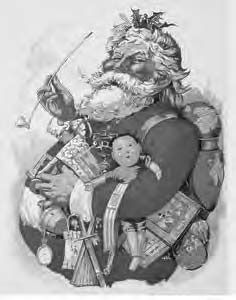
Thomas Nast’s most famous drawing of “Merry Old Santa Claus,” in 1881, which immortalized the present image of Santa Claus worldwide.