.jpg)
Abbott announces historic $1.4 billion in federal funding secured for ‘Rural Texas Strong’ projects AUSTIN – Governor Greg Abbott announced that Texas will receive a historic investment of over $1.4 billion in federal funding over five years to improve rural health care throughout the state.
“Rural Texans across the state will benefit from this historic federal investment. We will strengthen our rural hospitals, expand access to critical mental and physical health care, and help reduce chronic disease through wellness and nutrition initiatives,” said Governor Abbott. “I thank President Trump, Secretary Kennedy, and Administrator Oz for their efforts to improve rural health care for Texans and all Americans.”
The Centers for Medicare & Medicaid Services (CMS) notified the Texas Health and Human Services Commission (HHSC) that it is receiving funding through the Rural Health Transformation Program. As part of the One Big Beautiful Bill Act, the program is allocating $50 billion to states over five years to help transform rural health care. Texas will receive $281 million each year for five years, the most of any state in the program.
Texas submitted its application, “Rural Texas Strong: Supporting Health and Wellness,” to CMS in early November.
“We are grateful for the federal government’s investment in increasing access to preventive and lifesaving care for people who live in rural communities across the state,” said HHS Executive Commissioner Cecile Young. “Thanks to the input and partnership of our rural healthcare stakeholders, Texas now has the opportunity for innovative and tailored solutions that will improve health care for current and future generations of Texans.”
HHSC will use a competitive process to allocate funds for initiatives that:
• Offer grants to reduce chronic disease through prevention, wellness and nutrition services.
• Invest in consumer-facing technology to engage with patients on improving their health.
• Deploy artificial intelligence and telehealth services to bridge service gaps.
• Recruit and retain rural health care workers through career development, scholarships, relocation payments, and training programs.
• Improve cybersecurity defenses to protect patient data.
• Upgrade equipment in rural hospitals and clinics.
Local governments, rural hospitals, rural federally qualified health centers, rural behavioral health providers, and other qualified applicants will be eligible to apply for funding in the spring. More information will be available on the HHSC Grants webpage.
Abbott announces Texas Semiconductor Innovation Fund Grant to Prairie View A&M University
AUSTIN – Governor Greg Abbott announced that a Texas Semiconductor Innovation Fund (TSIF) grant of $1.98 million has been extended to Prairie View A&M University (PVAMU), a member of The Texas A&M University System, for a strategic workforce development initiative focused on advancing 3D Heterogeneous Integration (3DHI) microelectronics through a comprehensive training program at the campus in Prairie View.
“Texas is investing in the workforce of tomorrow today,” said Governor Abbott. “Prairie View A&M University, the second-oldest public higher education institution in Texas, has built an unparalleled reputation for empowering scholars. This specialized workforce training program will further Texas’ leadership in cutting-edge microelectronics, enhance national security by strengthening domestic semiconductor manufacturing, and expand the path to better jobs and bigger paycheck opportunities for Texans for years to come.”
Using 3DHI technologies creates the ability to stack separately manufactured components — chips or wafers containing different semiconductors and materials — within a single package, offering revolutionary improvements in functionality and performance.
The Roy G. Perry College of Engineering at PVAMU, as a Historically Black College and University (HBCU), is collaborating with the Texas A&M Semiconductor Institute and spearheading a strategic workforce development initiative in partnership with the Next-Generation Microelectronics Manufacturing (NGMM) program. The program will provide specialized training in 3DHI process capabilities, Electronic Design Automation (EDA) and digital twins, and 3DHI microsystems. This initiative is focused on educating and preparing a robust workforce for careers in these high-tech fields.
“I want to thank Governor Abbott for investing in Texas’ semiconductor workforce and providing a strong vision to maintain our state’s dominance in this critical sector,” said Texas A&M University System Chancellor Glenn Hegar. “Prairie View A&M University is preparing students for the most complex and in-demand jobs in the industry. This grant is an investment not only in Texas’ economic future, but also in the men and women whose skills will keep our state at the forefront of innovation for decades to come.”
“Texas is a global leader in developing innovative technology, and Prairie View A&M is at the forefront of that effort,” said Senator Lois W. Kolkhorst. “This important fund will help Prairie View A&M continue to create a highly educated workforce that is building a bridge to the future.”
Abbott signed the Texas CHIPS Act into law in 2023 to establish the Texas Semiconductor Innovation Fund (TSIF), a grant program to continue Texas’ leadership in semiconductor research, design, and manufacturing, as well as the Texas Semiconductor Innovation Consortium (TSIC). These programs, administered by the Texas CHIPS Office, a division within the Governor’s Texas Economic Development & Tourism Office, are designed to leverage Texas’ investments in the semiconductor industry, encourage semiconductor- related companies to expand in the state, further develop the expertise and capacity of Texas institutions of higher education, and maintain the state’s position as the nation’s leader in semiconductor manufacturing.
In 2025, Texas blazed the Trail to become No. 1 in education AUSTIN – Governor Greg AUSTIN — Governor Greg Abbott highlighted the strides the state made in 2025 to put Texas on the pathway to be No. 1 in education and empower parents to choose the educational opportunities best for their children.
“This year, Texas blazed the trail to become No. 1 in educating our students to ensure our state thrives for generations,” said Governor Abbott. “We passed school choice, expanded career and technical education opportunities, invested record funding in public schools and teacher pay raises, and brought curriculum back to the basics. Through these reforms, Texas will build a stronger future every child across the state.”
2025 Highlights from Texas Education Initiatives: Governor Abbott Signs Landmark School Choice Legislation Into Law In May, Governor Greg Abbott signed Senate Bill 2 into law, establishing the Texas Education Freedom Account (TEFA) program, at the Governor’s Mansion joined by hundreds of Texas parents, students, educators, and school choice advocates from across the state. With $1 billion in funding, the program will be the largest day-one launch in the country.
“When I ran for re-election in 2022, I promised Texans that we will bring education freedom to every Texas family,” said Governor Abbott. “Today, Texas delivers on that promise. I am signing this law that will ensure Texas families, whose children can no longer be served by the public school assigned to them, have the choice to take their money and find the school that is right for them. This success could not have been accomplished without the hard work of Lieutenant Governor Dan Patrick, Speaker Dustin Burrows, Chairman Brandon Creighton, Chairman Brad Buckley, and the tireless efforts of school choice advocates across Texas. Today is a historic day, where we come together at the Governor’s Mansion to proudly deliver school choice for Texans.”
Senate Bill 2 (Creighton/ Buckley) created the Texas Education Freedom Account (TEFA) program allowing eligible families to use funds for approved educational expenses and providers that best meet their child’s needs. The program prioritizes access for students with disabilities and families with the greatest financial need.
Governor Abbott Signs Record Public Education Funding, Teacher Pay Raise Into Law In June, Governor Greg Abbott signed House Bill 2 into law to provide a record $8.5 billion in new funding for public education including over $4 billion for teacher and staff pay raises.
“Now is the time to make Texas No. 1 in educating our children,” said Governor Abbott during the bill signing ceremony with over 175 educators, students, and parents. “House Bill 2 ensures that our schools are funded better than ever, teacher pay and student funding are at all time highs, reading and math performance will improve, and students will be better prepared for the workforce. The foundation is now in place for Texas education to start climbing the ranks.”
House Bill 2 (Buckley/ Creighton) delivers the largest investment in public education in Texas history, including $3.5 billion for permanent teacher pay raises and expanded incentive and retention allotments, $187 million to strengthen teacher preparation through paid classroom training, and $834 million to improve special education funding and services. The bill also invests $648 million in early literacy and numeracy, $153 million in career and technical education, and $430 million to increase the school safety allotment. In addition, HB 2 creates a new $1.2 billion allotment to help districts cover basic operating costs such as staffing, transportation, utilities, and insurance, along with targeted funding for small and mid-sized schools and charter facilities.
Governor Abbott Signs Laws To Expand Texas’ Career Training Programs This September, Governor Greg Abbott ceremonially signed House Bill 20 and House Bill 120 into law to expand career and technical education opportunities for students across Texas.
“Career training is a game-changer for our students, for our state, and for our employers,” said Governor Abbott. “A fouryear college degree is not the right pathway for every student. It may be a smarter pathway for a student to get career training. In just the past two years, the State of Texas has invested more than $7 billion in career training programs across Texas. Career training and technical education is bigger and better than it has ever been with the signing of these two laws.”
House Bill 20 (Gates/ Schwertner) establishes the Applied Sciences Pathway Program to allow 11th and 12th grade students to earn high school diplomas while concurrently completing certificate programs through partnerships with institutions of higher education (IHE). Through the partnerships, students may substitute graduation requirements with credits in career and technical education courses (CTE).
House Bill 120 (Bell/ Schwertner) strengthens college, career, and military readiness in Texas public school by expanding access to high-quality CTE programs. This bill also improves college and career advising by ensuing counselors use up-to-date workforce data, and providing funding for military training programs.
Governor Abbott Signs Child Online Safety, Phone-Free Classroom Laws In Amarillo In August, Governor Greg Abbott ceremonially signed Senate Bill 2420 and House Bill 1481 into law to create phone-free learning environments in classrooms and protect the safety and online privacy of Texas children.
“Educators and researchers have raised concerns about the impact that smartphones have on student learning and student engagement,” said Governor Abbott. “Experts have explained that smartphones and social media affect the mental health of children. If we are going to be number one in education, it is going to require the undivided attention of our students in the classroom.”
Senate Bill 2420 (Paxton/ Fairly) known as the App Store Accountability Act requires application (app) stores to verify a user’s age when creating an account. A minor’s account must be affiliated with a parent’s account and parental consent is required before a minor can download or purchase an app or make in-app purchases.
House Bill 1481 (Fairly/ Creighton) requires schools to adopt polices prohibiting students from using personal communication devices, such as cell phones and smart watches, during the school day. Polices must either prohibit personal devices on school property or provide a designated storage area for devices during the school day.
This year, Texas made significant investments in education, delivering on promises made during his 2025 State of the State Address. Those laws signed into effect strengthen parental rights and prioritizes classroom safety: House Bill 6 (Leach/ Perry) prioritizes classroom safety by expanding school authority to remove students for serious misconduct or violent behavior, while providing clearer protections for teachers managing disruptive classrooms and increasing parental involvement in discipline decisions. The bill establishes new virtual expulsion options, sets timelines for reviewing disciplinary placements, and requires parent notification and participation in behavioral agreements, while preserving due process and federal protections for students with disabilities.
House Bill 2674 (Cook/ Hagenbuch) prohibits the Texas Education Agency, the State Board of Education, and public education institutions from regulating homeschool educational programs.
Senate Bill 11(Middleton/ Spiller) authorizes a policy allowing a voluntary daily period of prayer and reading of religious texts for students and employees, subject to written consent requirements and restrictions ensuring non-participants are not present.
Senate Bill 12 (Creighton/ Leach) prohibits school-based Diversity, Equity, and Inclusion (DEI) policies and practices; reinstates parental opt-in for human sexuality instruction; and restricts instruction related to sexual orientation or gender identity. The bill creates a framework for parental access, notification, grievance procedures, and reporting.
Senate Bill 13 (Paxton/ Buckley) requires the Texas State Library and Archives Commission to adopt statewide school library standards prohibiting harmful, indecent, profane, or age-inappropriate materials across all student-accessible collections. The bill also authorizes parent-majority local library advisory councils and expands parental access to library records and catalogs.
Senate Bill 204 (Paxton/ Leo-Wilson) requires the Texas Education Agency to develop, publish, and annually update a plain-language, searchable Parental Rights Handbook and directs the State Board of Education, in coordination with TEA, to establish mandatory parental rights training for school district trustees.
Senate Bill 260 (Huffman/ Bonnen) increases both the per-student safety allotment and the base per-campus amount. This allotment may be used for a wide range of school safety expenditures including hiring armed security personnel, improvements to school infrastructure, and the purchase of security technology including panic alert devices.
Senate Bill 571(Bettencourt/ Leach) expands educator misconduct laws and the TEA Do Not Hire Registry to apply to contractors, subcontractors, service providers, and other noncertified personnel. The bill requires misconduct involving criminal conduct to be referred to an external law enforcement agency, provides for temporary registry placement during investigations, and adds new categories of reportable misconduct, including inappropriate communications and failure to maintain appropriate boundaries with students or minors.
Senate Bill 965 (Parker/ Leach) codifies the right of public school employees to engage in religious speech or prayer while on duty.
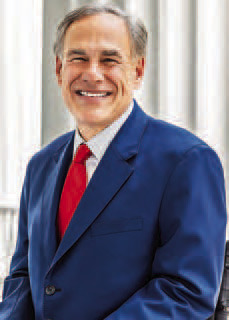
Gov. Greg Abbott Courtesy photo