.jpg)
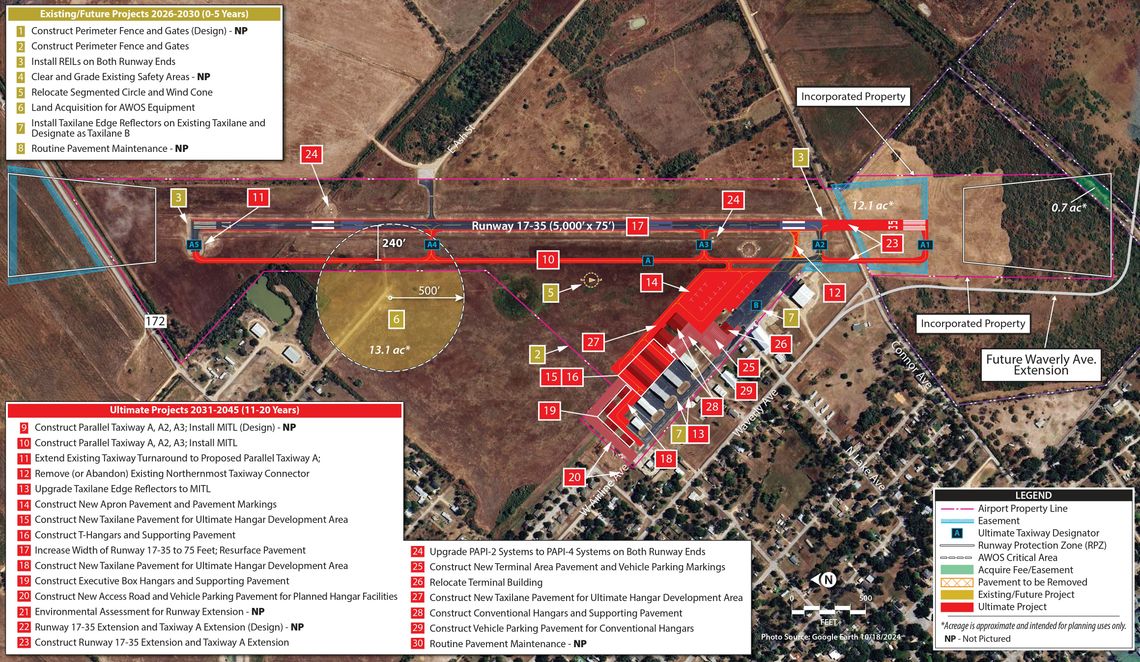
Eagle Lake Regional Airport closed out the second phase of its 20-year airport development plan with a capital improvement program, a recommended development concept and an in-progress draft.
An Airport Layout Plan (ALP) serves as a short- and long-term planning document to guide city and airport officials through airport developments. In spring 2025, Eagle Lake began the process to update the previous version from 2017, originally written in 2003. The first phase of the study addressed inventory, forecasts, facility requirements and development alternatives.
“The [Federal Aviation Administration (FAA)] recommends that public-use airports update their ALPs periodically to ensure current planning standards are being met or are planned to be met, reflect the airport’s as-built condition, and plan for future development,” the study’s website reads. “Significant changes in the industry have occurred since the last ALP update, necessitating an update to the plan.”
The updated ALP will also bring the airport up to date with regulatory changes by the Federal Aviation Administration and Texas Department of Transportation to ensure uninterrupted eligibility for funding opportunities for future projects.
The study’s full details and documents can be viewed at: www.eaglelake.airportstudy.net
Capital improvements
The capital improvement program details a total capital investment of $31.2 million to be divided among 30 total projects over the next 20+ years. TxDOT requires airports to submit a five-year capital improvement program each year, so this program seeks to outline projects that would require federal or state grant funding to assist in the airport’s future planning and decision making.
“The format of this plan reduces the need for formal and costly updates by allowing airport management to simply adjust the timing of project implementation,” the draft ALP reads.
The program identifies eight existing or future projects “to be needed over the next five years and are primarily safety-related” that total $2.25 million in capital investment. The airport will prioritize constructing a 17,500-foot perimeter fence for safety and security. Other notable short-term projects include installing runway end identifier lights and a 13.1acre land acquisition to protect the automated weather observing system.
The remaining 22 long-term projects outline development needed beyond the next five years that are “reflective of capacity enhancements” and total $28.95 million in capital investment. The largest long-term project will be the construction of a parallel taxiway and associated connectors serving Runway 1735. Other future construction includes extending Runway 17’s taxiway turnaround, two new T-hangers and the hangers’ supporting taxilane pavement.
The program estimates almost equal cost shares between the FAA plus TxDOT at $15.9 million and local shares plus potential airport sponsor(s) at $15.3 million. At close look, the share percentage varies drastically from project to project. According to the ALP draft, projects that are eligible for federal or state funding may receive grants to provide up to 90% of the total project cost. However, some projects do not qualify for any federal or state funding.
“There are several local financing options to fund future development at airports, including airport revenue, issuance of a variety of bond types, and leasehold financing,” the draft reads. “These strategies could be used to fund the local matching share or complete a project if grant funding cannot be arranged.”
Development plan
The recommended development plan takes a mathematical and graphical approach to airside and landside development. The plan outlines the required dimensions and locations for (airside) runways, taxiways, approach aids and instruments, weather reporting equipment, (landside) hangars, apron and aircraft parking, terminals, vehicle parking, fuel storage, fencing and reserve land.
“The plan represents an airfield facility that fulfills aviation needs for the airport while conforming to safety and design standards (to the extent practicable),” the draft ALP reads. “It also provides a landside complex that can be developed as demand dictates.”
The plan emphasizes flexibility in case of unpredictable development or regulation changes.
Next steps
The study has now entered the last phase which entails an environmental review, a recommended airport layout concept and the finalization of the draft ALP. The environmental review will identify potential environmental concerns to be addressed before implementation of the recommended development program. A public information workshop will be held once the draft of phase three’s materials has been completed.
Once the ALP is finalized, the report will undergo local approval followed by approval from TxDOT and the FAA. A presentation from the airport’s Planning Advisory Committee on Feb. 12, 2026, estimated for the final deliverables to be completed in spring 2026, dependent on government approvals.