Go to main contentsGo to main menu
Wednesday, August 19, 2026 at 6:57 AM

Rice Junior High climbs from F to C in state accountability rating

Rice Junior High climbs from F to C in state accountability rating
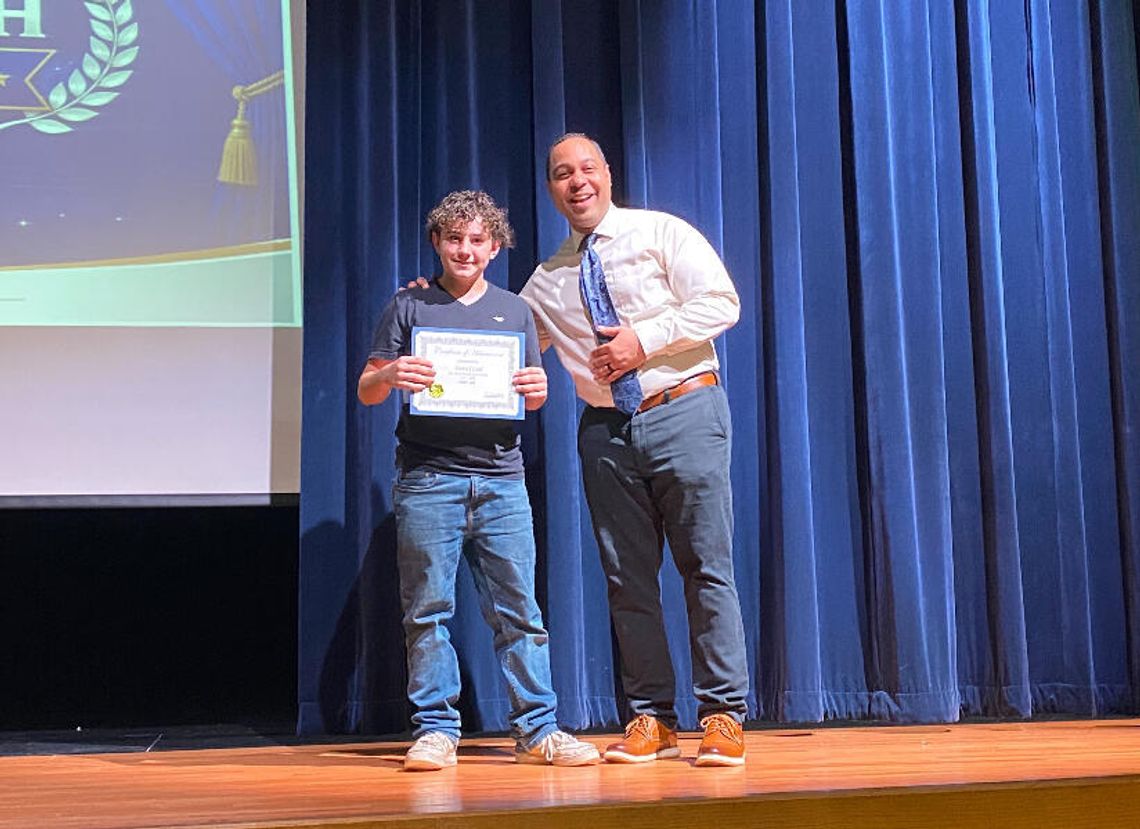
RJH Principal Dr. Andrew DeWalt presents RJH student Sam Leal with his awards at the end of year awards ceremony in May. Citizen | Alesia Woolridge

ALTAIR — After two consecutive years with an F state accountability rating, Rice Consolidated Junior High School climbed 18 points to earn a C rating for 2026, an improvement district leaders say reflects changes in instruction, intervention and campus culture.

The Texas Education Agency released its latest accountability ratings last week, giving Rice Junior High an overall scaled score of 73. The campus received an F with a score of 55 for the 2024-25 school year and an F with a score of 58 the previous year.

“For the last two years, Rice Junior High School has had an accountability rating of F. To see it go to a C is amazing,” Rice CISD Superintendent Kendall Center said. “The students, staff and administration have been working hard, and to see this hard work pay off is well deserved.”


Principal Dr. Andrew DeWalt, who took over leadership of the junior high last school year, said the improvement is evidence that changes implemented across the campus are beginning to produce results.

“Going from an F rating to a C rating is significant progress, and I would say that we view it as proof that our systems are beginning to work, but not as an end to the work,” DeWalt said.

Changing the system When DeWalt arrived at Rice Junior High, he identi fied consistency in instruction, planned intervention, student expectations and the use of performance data as areas needing improvement.

Professional learning communities, or PLCs, were strengthened with a greater focus on individual student performance and mastery of the Texas Essential Knowledge and Skills.

The campus also established clearer instructional expectations through the Get Better Faster and Fundamental Five frameworks and refined intervention during WIN — What I Need — periods as required by House Bill 1416.

DeWalt said administrators and staff also worked to strengthen campus routines, attendance expectations and school culture.

“The improvement was not the result of one program,” DeWalt said. “It came from our staff becoming more consistent and intentional every day.”

Those changes became visible beyond state testing results.

DeWalt said teachers began having more informed conversations about individual students, using data to adjust instruction and collaborating more intentionally across grade levels.

Classrooms incorporated clearer learning targets, additional writing opportunities across subject areas, classroom discussion, and planned checks for student understanding.

Students also began recognizing the connection between their own attendance, effort, and academic growth, DeWalt said.

“Those changes told me we were moving in the right direction before we ever received the final rating,” he said.

Building on the improvement

The C marks a significant turnaround for a campus that has struggled in state accountability measures in recent years.

Rice Junior High received a D with an overall score of 67 in 2019 and was identified for comprehensive support and improvement. State accountability ratings were suspended during the following two school years because of the COVID-19 pandemic.

The junior high returned with a C and a score of 76 for the 202122 school year before falling to a D in 2022-23 and F ratings during the following two accountability cycles.

DeWalt said one of the most important lessons from the latest results is that previous ratings did not define the potential of Rice Junior High students.

“The biggest lesson is that our students are capable of much more than a previous rating may have suggested,” DeWalt said.

The campus isn’t treating its new C as the finish line.

DeWalt said administrators and teachers will continue working to strengthen Tier 1 instruction, PLCs, student interventions, growth monitoring, attendance and campus culture.

“The goal is not simply to improve a letter grade,” DeWalt said. “The mission is to build sustainable systems that facilitate strong instruction, high expectations and continuous improvement as the way Rice Junior High operates.”

Center echoed that the work is not complete.

“The journey and the work isn’t complete as we will continue to push the students to meet the level of expectations that we have set forth, but we are extremely proud of all their hard work and they deserve to be celebrated,” Center said.

Rice CISD also remained a C-rated district in the latest accountability results, but Center said its overall score improved from the previous school year. The district has shown steady progress with 2024, 2025, and 2026 scores of 71, 73, and 76 respectively.

“We want to continue to progress in the right direction to where the district has an overall rating of an A as we prepare students to be successful citizens,” Center said.

For Rice Junior High, DeWalt said the latest results establish a foundation on which the campus can continue building.

“I am proud of our teachers, staff and students,” he said. “The improvement shows that progress is possible. Now our responsibility is to continue building on it.”

Editor’s note: The author, Alesia Woolridge, serves as area editor for The Colorado County Citizen and is also a teacher at Rice Consolidated Junior High School.

RICE JUNIOR HIGH SCHOOL

SCHOOL YEAR TEA RATING OVERALL SCORE

2018-19 D 67 2019-20 Not Rated — 2020-21 Not Rated — 2021-22 C 76 2022-23 D 69 2023-24 F 58 2024-25 F 55 2026 rating C 73

State accountability ratings were suspended or designated “Not Rated: State of Disaster” during the COVID-19 pandemic.

Rice Junior High was identified for comprehensive support and improvement following its 2018-19 rating.

Accountability history is available at the Texas Education Agency.


Share
Rate

Ad
Ad
Ad
Ad
Ad