From gunfights and whiskey to art exhibits and wine, one of Columbus’ historic buildings has more than a century of stories to tell.
Footsteps echo from the upstairs gallery, but no one is there.
A door slams somewhere in the building. Muffled voices and the sounds of people socializing drift through the rooms, even though no gathering is taking place.
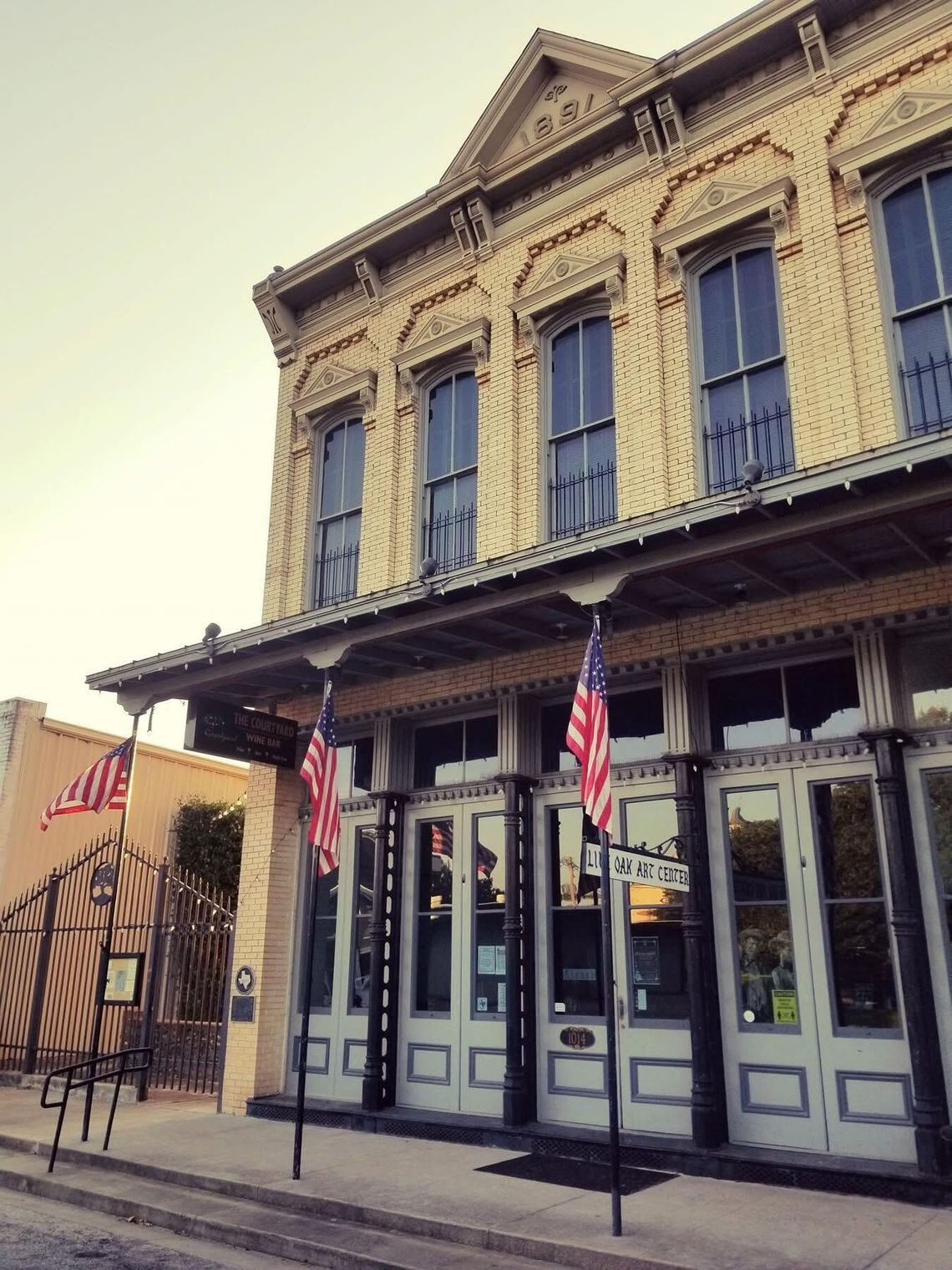
These are among the unexplained experiences reportedly described by former employees of the Live Oak Art Center in downtown Columbus, a building whose colorful past includes whiskey, gunfights and some of the most turbulent years in Colorado County history.
Today, the Live Oak Art Center and Courtyard Wine Bar welcome visitors for art exhibitions, community events and social gatherings. Laughter, conversation and music fill the spaces that once welcomed patrons of the Brunson Saloon.
But according to local ghost stories, some of those conversations may not have ended when the saloon closed more than a century ago.
A SALOON WITH A COLORFUL PAST
The building’s history dates to Charles Brunson, a German immigrant who settled in Columbus and established a saloon on the courthouse square in 1867.
According to the Texas Historical Commission, Brunson’s business prospered, and in 1891 he constructed the building that now houses the Live Oak Art Center. An adjoining store was added in 1896.
The saloon became a gathering place during an era when Columbus was anything but a quiet Texas town.
The Live Oak Art Center’s historical account notes that restrictions on carrying firearms meant patrons sometimes left their weapons at local saloons while conducting business in town.
Texas Time Travel, a heritage tourism program associated with the Texas Historical Commission, also describes the Brunson Saloon as a place where weapons were stored. In 1906, local officials adopted a resolution restricting the storage of firearms in locations where they could be readily accessed during disputes.
The precautions were not without reason.
During the late 19th century, Columbus was the scene of a series of deadly confrontations associated with the Stafford-Townsend feud and the later Colorado County Feud.
According to the Texas State Historical Association, the violence included the 1898 killing of sheriff candidate Larkin Hope and the death of former Sheriff Sam Reese during a downtown gunfight in 1899. Several additional gun battles followed, leaving more residents dead or wounded.
The Live Oak Art Center’s historical account associates shootings in and around the Brunson Saloon with the deaths of Hope and Reese. The Texas State Historical Association independently documents both killings in downtown Columbus, although its account does not establish that either man died inside the saloon.
It was a violent chapter in the community’s history, and one that has become intertwined with stories about the old building.
FOOTSTEPS, VOICES AND UNEXPLAINED VISITORS
More than a century after Brunson served his customers, stories of unusual activity continue to surround the historic property.
According to accounts attributed to former employees, some have reportedly seen apparitions inside the building.
Others have described hearing footsteps from the upstairs gallery when no one else was present.
There are also stories of doors slamming unexpectedly and muffled conversations drifting through otherwise quiet rooms.
Perhaps the most intriguing reports involve sounds resembling people talking and socializing, reminiscent of the activity that once filled the building during its saloon years.
Local paranormal lore suggests the building’s history may have left something behind. Some ghost-story enthusiasts speculate that the sounds and sightings could be echoes of the saloon’s former patrons or workers.
There is, however, no verified evidence establishing a supernatural cause for the reported experiences, and the accounts remain part of the building’s folklore.
FROM WHISKEY TO WORKS OF ART
The Brunson Saloon operated until approximately 1919. The building subsequently housed other businesses before becoming home to the Live Oak Art Center in 1986, according to the center’s historical account.
Much of the building’s original character remains.
Its Victorian architectural details recall the late 1800s, while the original wooden floors provide a tangible connection to the generations who walked through the building.
Visitors to the Courtyard Wine Bar can even encounter a particularly interesting piece of history: Brunson’s original saloon bar, which remains in use today.
Where customers once gathered for whiskey, visitors now enjoy wine and conversation. Where a bustling saloon once operated, artwork fills the gallery spaces.
The building’s purpose has changed dramatically, but its history remains an important part of downtown Columbus. Whether the unexplained footsteps and voices are the product of an active imagination, the ordinary sounds of an aging structure or something less easily explained is left to those who hear them.
For now, the old Brunson Saloon continues its second life as a center for art and community gatherings.
Historical sources: Live Oak Art Center; Texas Historical Commission; Texas Time Travel; Texas State Historical Association, Handbook of Texas, “Colorado County Feud.” Paranormal accounts are based on locally reported experiences and have not been independently verified.