GHOSTS OF COLORADO COUNTY
Not every Colorado County community that disappeared from the map was once a bustling town. Some were little more than a collection of homes, a schoolhouse, and a few businesses serving the families who lived nearby.
Ramsey was one of those places.
Located approximately six miles northwest of Eagle Lake along what is now Farm Road 102, the community once had a railroad station, a cotton gin, a grocery store and schools serving local children.
Although little remains of Ramsey today, historical records offer glimpses of the families who lived there and the community they built.
Perhaps one of its most significant distinctions is its place in the history of education in Colorado County.
A SCHOOL FIRST, THEN RAILROAD STOP Long before Ramsey became an established railroad stop, children were attending school in the area.
According to the Texas State Historical Association, a school known as Ramsey’s Point served 18 Black students as early as 1883.
That record offers an important glimpse into education for Black children in rural Colorado County during the years following Reconstruction, when schools remained segregated and educational opportunities were often limited.
By 1896, the community also had a school designated for white students, with an enrollment of 23.
Records preserved by Colorado County historical researchers provide additional details about Ramsey’s Point school.
A school record dated Sept. 1, 1888, identifies J.R. Alley as a sub-trustee and H.M. Johnson and S.S. Lott as trustees.
The record also includes the names and ages of 35 children, ranging from 8 to 15 years old.
Among the families represented were the Alleys, Clapps, Causeys, Dukes, Harrises, Hildebrands, Hoovers, Neals, Schindlers, Strahans and Woffords.
Whi le the surviving records do not establish that every child attended the same school or identify the race of the students listed in 1888, they do provide a rare snapshot of the families living in the area.
More than a century later, those names remain part of the written history of a community that otherwise might be forgotten.
SAME TOWN, SEVERAL NAMES
Ramsey did not always go by the name that eventually appeared on highway maps.
Histor ical accounts identify the settlement by several names, including Ramsey’s Point, Nigh and Ramseyville.
The name Ramsey may have originated with Martin D. Ramsey, an early settler in the area.
By the late 1880s, the community had become a stop on the San Antonio and Aransas Pass Railway, connecting local residents and agricultural businesses to larger markets.
Railroad activity helped establish Ramsey as a small commercial center.
By 1894, the Southern Pacific Railroad had a depot and section house in the community, along with Wells Fargo express service and telephone access, according to records compiled by Colorado County historical researchers.
That same year, J.R. Alley operated a mill and cotton gin in Ramsey.
For farmers in the surrounding countryside, those services meant crops could be processed and shipped without traveling to a larger town.
The railroad also provided an important connection to nearby communities, including Eagle Lake.
A POST OFFICE AND A GROCERY STORE
Like many small Texas settlements, Ramsey’s changing names were reflected in its postal history.
Records compiled by Colorado County historians identify John R. Alley as postmaster of Nigh beginning March 14, 1892. Postal service associated with Nigh was transferred to Eagle Lake on Jan. 31, 1900.
A post office later opened under the name Ramseyville on Jan. 10, 1916, again with Alley serving as postmaster.
That office operated for less than two years before postal service was transferred to Alleyton on Oct. 31, 1917.
Although the post office closed, the community continued to exist.
By 1923, records identify H.D. Swearingen as the operator of a grocery store in Ramsey. The store may have been in operation earlier, but 1923 is the earliest reference identified in the local historical account.
For a small rural settlement, the combination of a school, railroad facilities, cotton gin and grocery store provided many of the services residents needed in their daily lives.
FADING FROM THE MAP Ramsey remained a sma l l communit y throughout its history.
By 1939, the settlement reportedly consisted of one business and approximately 20 residents.
As transportation improved and rural families increasingly relied on larger nearby towns for shopping, employment and services, small communities such as Ramsey gradually lost their commercial importance.
By 1981, historical accounts described Ramsey as a scattering of dwellings rather than an active town center.
Its name continued to appear on state highway maps as late as 1990, preserving a geographic reminder of the settlement that had once stood along the railroad.
REMEMBERING WHAT REMAINS
Unl ike ghost towns whose histories are filled with abandoned hotels, saloons or dramatic tales of frontier violence, Ramsey’s story is found in ordinary details.
Cotton gin, train depot, grocery store and schools.
Those records are especially meaningful because they document the existence of a school serving Black children in 1883, preserving a piece of local educational history that might otherwise have been overlooked.
Ramsey may never have been a large town, but for the people who lived, worked and attended school there, it was home.
And although small, the community still has residents, and its place in Colorado County history remains.
Hi s tor ical information for this article was drawn from the Texas State Historical Association’s Handbook of Texas entry on Ramsey and records compiled by Colorado County historical researchers at Colorado-CountyHistory.org.
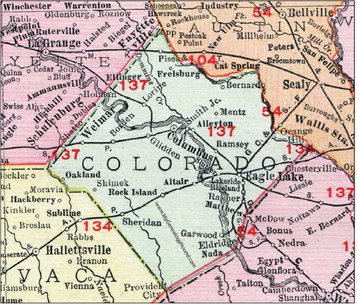
This map of Colorado County from 1911 shows the location of the Ramsey community. Sourced from mygenealogyhound.com/