.jpg)
Editor’s Note: To make information about the upcoming Rice CISD bond election accessible to more district residents, a Spanish-language translation of this article is available here.
ALTAIR — Rice Consolidated Independent School District trustees unanimously approved placing a $55 million bond proposal on the November ballot for a new consolidated elementary school, district renovations, security improvements and additional school buses.
The proposed bond would consolidate students from the district’s four existing elementary campuses into one new school. District officials estimate consolidation would save approximately $1 million annually in operating costs.
“(The board) has thought long and hard how can we make sure to sustain the district…not just short term but long term,” Superintendent Kenny Center said. “As it was mentioned, when we are gone from here, the district, we want it to thrive.”
If approved, the bond would increase the district’s tax rate by $0.303 per $100 of taxable value. A homeowner with the district’s median home value of $151,240 and a $140,000 homestead exemption would pay an additional $2.83 per month. Homeowners with an over-65 homestead exemption would not see an increase in their district taxes.
Around a dozen community members attended the Aug. 6 meeting, with several speaking against the proposal before the board’s presentation. Concerns included whether the district could afford a new building while facing extensive deferred maintenance and the effects consolidation could have on the communities losing their schools.
Kristin Dye, a member of the Garwood Association of Parents, said she was concerned about promises made regarding consolidation and keeping elementary students separated from older students.
“My main concern is if it’s consolidated, you’re sitting here today going to make all these promises to us, and you’re going to be off the board in years,” Dye said.
The board discussed holding community information sessions in Garwood, Sheridan, and Eagle Lake before the election. Details are expected to be determined at a future meeting.
Bond breakdown
Of the $55 million proposal, $47.75 million would fund construction of the consolidated elementary school, $6.29 million would fund district renovations and high school security improvements, and $960,000 would expand the district’s school bus fleet.
The district estimates construction of the new elementary campus would cost $73,304 per student.
“The proposed bond program is intended to address aging elementary facilities, improve safety and security, and eliminate the costs of operating and maintaining four separate elementary campuses,” a district report stated. “After reviewing Rice CISD’s facility conditions, enrollment trends, operational costs and long-term needs, the Community Bond Advisory Committee (CBAC) recommended consolidation and reduction of budgetary obligations.”
The district did not present specific details on the proposed renovations or high school security improvements.
Community members also raised concerns online and during the meeting about bus reliability and student transportation along U.S. Highway 90 Alternate.
“I don’t foresee the need for a school here in Altair when a majority of our population is in (Garwood, Sheridan and Eagle Lake). Why would we ship our students here?” Rice High School alumnus Cody Wiggington said. “…I’ve talked to quite a few of my companions from high school… We will consider sending our kids to another district than sending them to Altair.”
If voters reject the bond in November, the district has not outlined a definitive plan for addressing the cost of maintaining its aging and underutilized campuses. District officials indicated a bond proposal could be reconsidered in the future.
New elementary concept
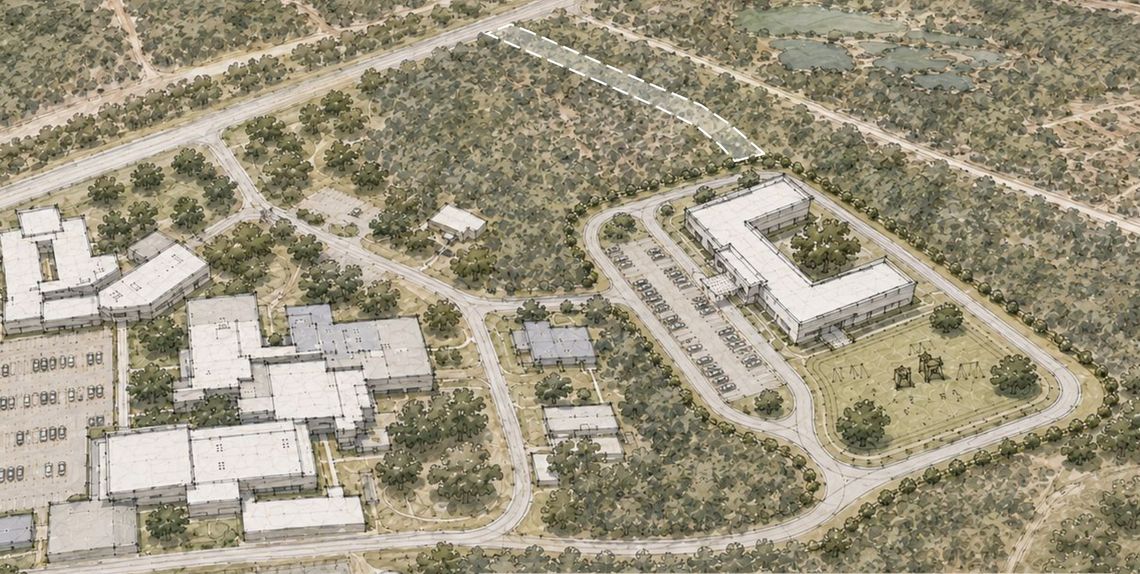
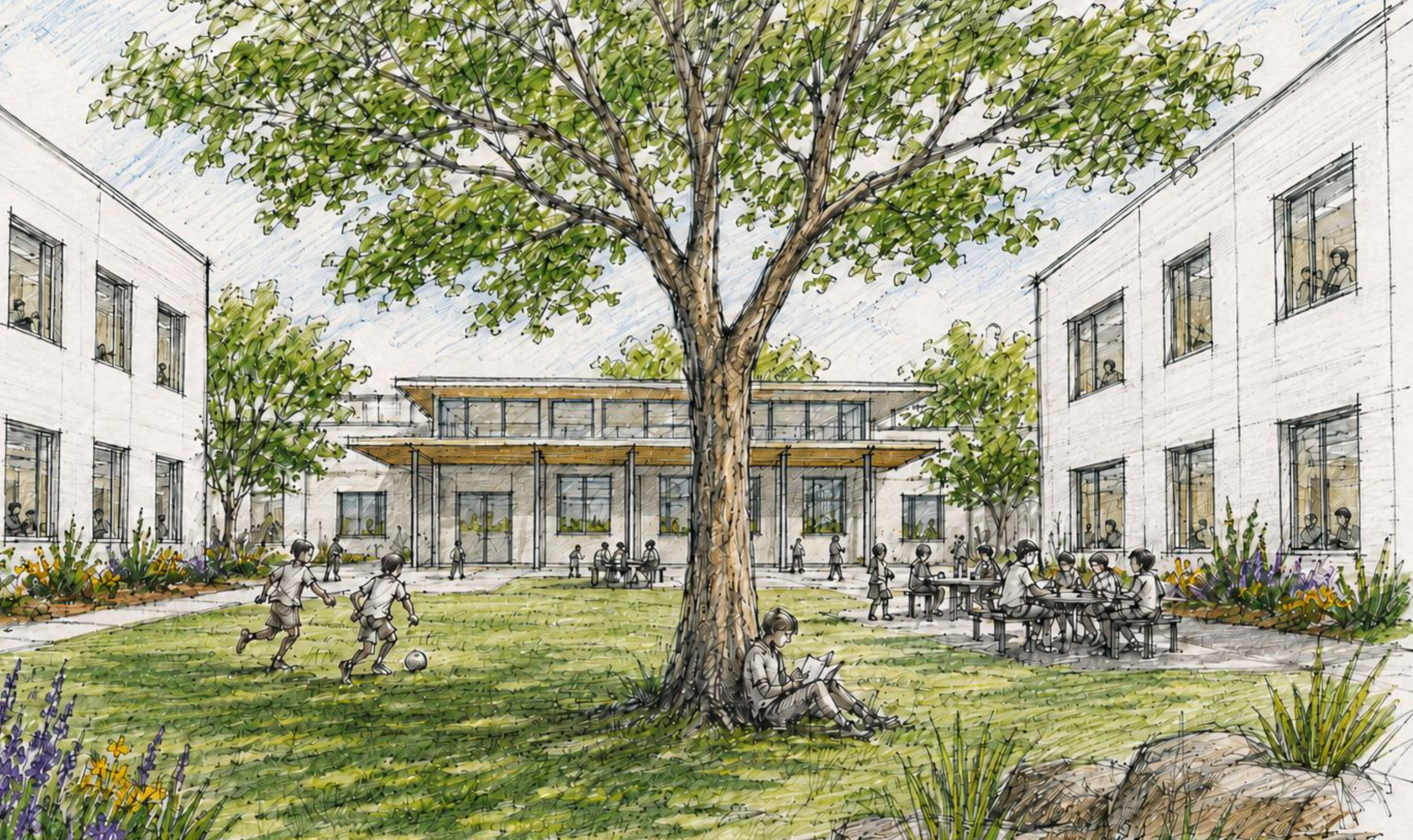
The proposed elementary campus would accommodate 650 students in an 83,293-square-foot facility. Plans include nearly 25,000 square feet of core classrooms designed for 22 students each, a 4,600-square-foot library, 7,650-square-foot cafeteria and 7,570 square feet dedicated to physical education.
Center said consolidation would also reduce travel time for district personnel, including mental health counselors and nurses who currently serve multiple campuses.
“Mental health is really important…The elementaries do not have a full time (counselor); they have to share them,” Center said. “Our counselors at the elementary would leave where they’re at at the drop of a dime to go where is needed… But having one full-time goes a long way. To be able to be in an immediate crisis response is important.”
The campus would be located east of the district administration building with its own entrance from U.S. Highway 90 Alternate. Center said the proposed design would keep elementary students separated from secondary students.
“We’ve heard a lot of trying to keep the elementary kids away from the secondary,” Center said. “The committee 100% agreed with that and wanted to do that.”
The two-story design would also reduce the number of trees and other vegetation removed during construction, according to Center.
If voters approve the bond, design work would begin immediately and continue through 2027. Construction would begin in 2028, with the district targeting the 2029-30 school year for completion of the elementary campus and other bond projects.
Heathyr Briscoe, a Garwood community member, questioned what would happen to the existing campuses and the potential economic effect of closing community schools.
“All the businesses around (Garwood Elementary School) are going to be affected because people go to the gas station after they pick up their kids from school, they go to Dollar General when they come back from school,” Briscoe said. “That’s the only businesses we really have there… The school is the nucleus of the community.”
Center said the district’s goal would be to sell the existing elementary campuses, potentially with restrictions on buyers and future uses. A board member also noted a community suggestion that the district inquire whether Colorado County might be interested in purchasing a campus for office or training space.
Deferred maintenance, funding concerns
A facilities study estimated renovating the district’s existing elementary campuses would cost a combined $66.9 million to $76.6 million.
Estimated renovation costs range from $80,710 to $223,225 per student, depending on the campus — at least $7,400 more per student than the district’s estimated cost of constructing the consolidated elementary school.
“(The renovation estimates) is just what is recommended; this is not something that would say everything needs to be replaced tomorrow,” Center said. “…These are things that have to be planned for and budgeted for. Those things can be extensive… when you go dive into one thing, you typically find something else that comes up that you didn’t plan for.”
Center said full HVAC replacement is among the recommended renovations at multiple campuses. Sheridan Elementary School and Eagle Lake Intermediate School also have undersized libraries. Center said renovations completed at Eagle Lake Intermediate in 2010 did not address all of the campus’ needs, and administrators recently discovered a water leak there.
“Garwood has not had a working air conditioner in their gymnasium for about six years...Even though I grew up on the south side of Chicago, I’ve never seen a school that dilapidated,” Briscoe said. “My question is if you cannot keep up with the school that you currently have, how can we trust that this new school will be kept up?”
When Center became superintendent at the end of the 2024-25 school year, the district had budgeted for a $ 200,000 deficit but finished the year with a balanced budget following spending reductions and decisions about which repairs could be completed.
Center said the district proposed a balanced budget for 2025-26 but could still incur a deficit to cover unforeseen expenses. Financial pressures and the outcome of the 89th Texas Legislature contributed to the district beginning its examination of consolidation.
“We have to make sure that we continue to financially operate in the best possible way and have that healthy fund balance available, so when something unexpectedly happens, we are able to take care of it. That is the most important thing,” Center said.
In addition to the facilities study, the district completed a demographic study earlier this year. Texas school districts receive state funding based partly on average daily attendance rather than total enrollment.
The study projects elementary enrollment will decline during the next five years. By 2035-36, enrollment is projected to be only 2.01%, or 24 students, higher than in 2025-26.
“If enrollment goes down…(average daily attendance) goes down, which means the funding we overall get goes down, but the operational cost involved in the elementaries and all the schools doesn’t change,” Center said. “We still have to pay everything out that we are currently doing now, but now we are getting less funds than we had to make the payments.”
During the 89th Texas Legislature, lawmakers approved $1 billion for private school education savings accounts and $750 million targeted toward teacher salaries and retention. Center said additional state funding came with restrictions, did not account for inflation and did not fully address transportation costs.